
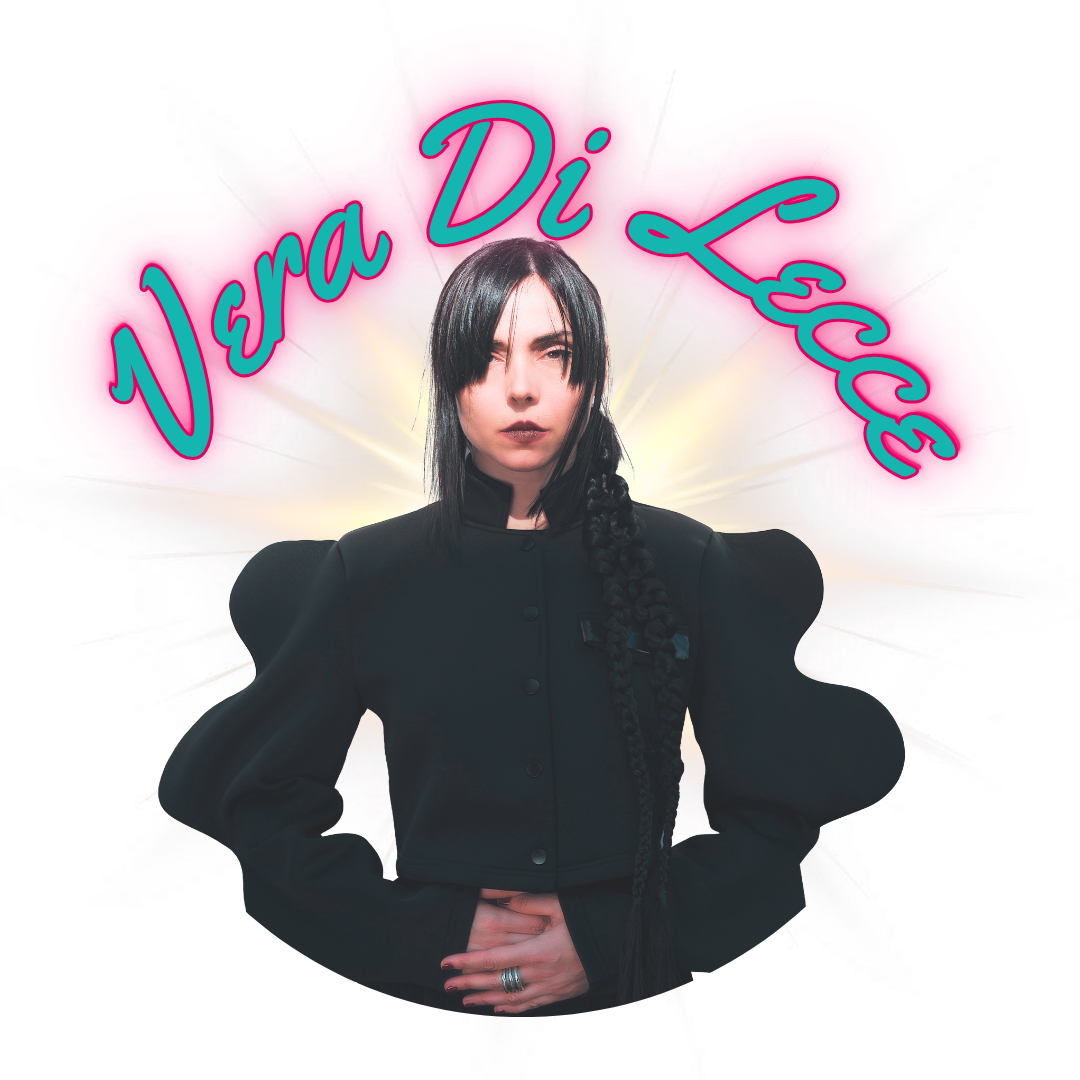
Vera Di Lecce is a singer, musician, and performer from Salento. Her work intertwines tradition and contemporary languages, exploring the voice as a tool for liberation and rootedness. She sings in Salento dialect, Griko, and English, layering her vocals over soundscapes that blend percussion, synthesizers, and ancient melodies into a ritualistic dimension of listening and transformation.
She has collaborated with Cesare Basile, Alfio Antico, Mai Mai Mai, Arakne Mediterranea, and Nidi d’Arac. Her solo project began in 2012 and reached its synthesis with the album Altar of Love (Manimal Vinyl/Niafunken, 2022), which she toured across Europe and the United States, including showcases at SXSW (Austin) and the New Colossus Festival (New York).
Her musical writing traverses oral tradition, medieval influences, vocal experimentation, and contemporary electronics, moving through a territory where memory and the present intersect, generating new forms of listening.
In 2023, she composed the music for Stuporosa, a choreographic exploration of ritual weeping by Francesco Marilungo, in which she also performed as a musician and onstage performer. The work won the 2024 Ubu Prize for Best Dance Performance and earned her a nomination for Best Sound Design or Original Music.
During the same period, she arranged and performed the soundtrack for Le mouvement n'échappe pas à la froideur de la pierre, a visual and musical poem expressing the strength of women and their power against violence and oppression. This artistic installation, conceived by Ludivine Large-Bessette, was presented in Lille at the Espace le Carré contemporary art center.
In 2025, she continued her collaboration with Francesco Marilungo by composing and performing the music for Cani Lunari, a work inspired by the figure of the Macara.
Parallel to this, she leads workshops on the voice as a practice of presence, listening, and awareness, offering experiential journeys dedicated to rediscovering the original voice. She also performs Canto Antico, a sound immersion performance rooted in Salento’s oral tradition, transforming it into living, contemporary matter. Through voice, breath, percussion, and minimal electronics, she creates a shared space of listening where memory, perception, and imagination intertwine. It is a contemporary ritual that invites reconnection with a deep sonic memory and the part of being that still remembers, regenerates, and resonates.